Background
A Tamil-language digital news property with multi-million monthly pageviews, predominantly Indian audience with a growing diaspora readership across Southeast Asia, the Middle East, UK, Canada, Australia and the US. The site was monetising through Google AdSense and Google Ad Manager but had not systematically reviewed its programmatic setup.
Traffic was not the problem. The gap was between what each page was earning and what it could earn. That gap turned out to be substantial.
Diagnostic findings — before the experiment
Ad formats were not fully configured — a significant category of in-page formats was generating zero impressions. Roughly 60% of Indian pageviews were earning nothing from ads at all.
No floor prices were set across any geography. Low-value and near-zero eCPM advertisers were winning auction slots unopposed, suppressing blended impression RPM across all markets.
Revenue per page was proportionally lower than revenue per impression — confirming that the issue was structural, not audience-related. Better traffic monetisation, not more traffic, was the lever.
Methodology
Experiment → Observe → Analyse → Feedback → Rethink
Each change was treated as a hypothesis. Positive signals were amplified. Negative signals were diagnosed and corrected before compounding.
Initial floors were set too aggressively in one geography — fill rate dropped sharply within hours. A second geography had floors set too low to filter anything meaningful. Both were corrected within 24 hours after early detection flagged the divergence.
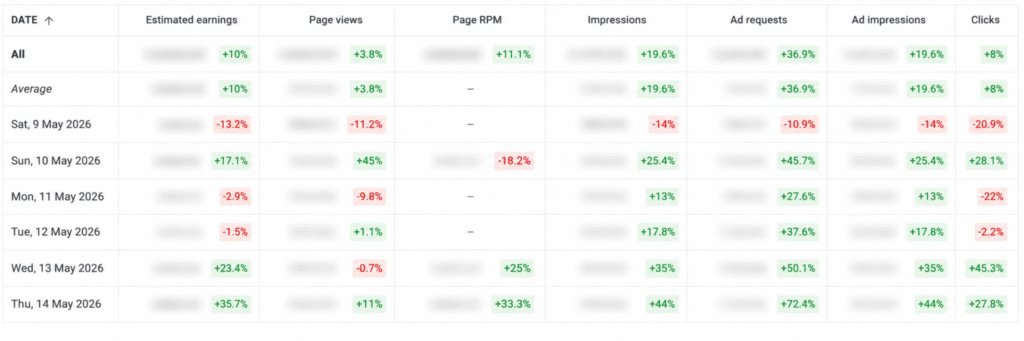
Enabling previously inactive in-page formats increased impressions per page by over 20%. Impression RPM initially dipped as new lower-CPM slots were introduced — a known short-term dilution effect. Held the position.
Manual floors replaced or supplemented by algorithm-optimised floors in markets where fill rate and RPM data indicated auto-optimisation would outperform static rules. Separate rules created for markets with different bid density profiles.
Revenue, impressions per page, fill rates and impression RPM all moved in the right direction simultaneously. Ad inventory quality review surfaced near-zero eCPM advertisers still bypassing floor prices — these were blocked directly at the ad server level.
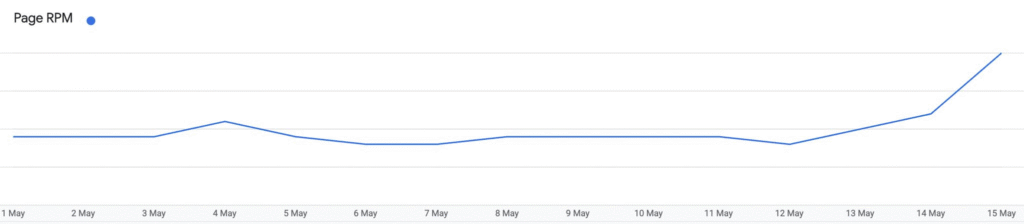
Results — days 5 through 7
Role of AI in the process
AI was used throughout as a co-analyst — not to make decisions, but to do something more specific: detect directional signals earlier than the data alone would suggest.
Early trend detection. While a metric was still within acceptable range, AI flagged the trajectory — “if this continues, the experiment will go wrong in 48 hours.” That lead time allowed intervention before damage accumulated.
AI suggestions were treated as one input. Sometimes the call was to act immediately. Sometimes: “let’s hold a little longer.” The AI adapted to that rhythm. Root cause analysis, pattern recognition and early warnings — AI. Final call — human.
It is less “AI did this” and more “we figured it out together.”
What this is not
This is not a traffic growth story. Pageviews did not change materially during the experiment window. No new content was produced. No SEO or social strategy was involved.
The gain came entirely from closing the gap between what the existing audience was worth and what the ad setup was capturing. That gap exists on most digital properties. It is usually larger than it looks.
This experiment is seven days old. The results so far are directionally strong, but holding, compounding or revealing new problems to solve is the real test. A follow-up will be published when there is enough data to draw durable conclusions.