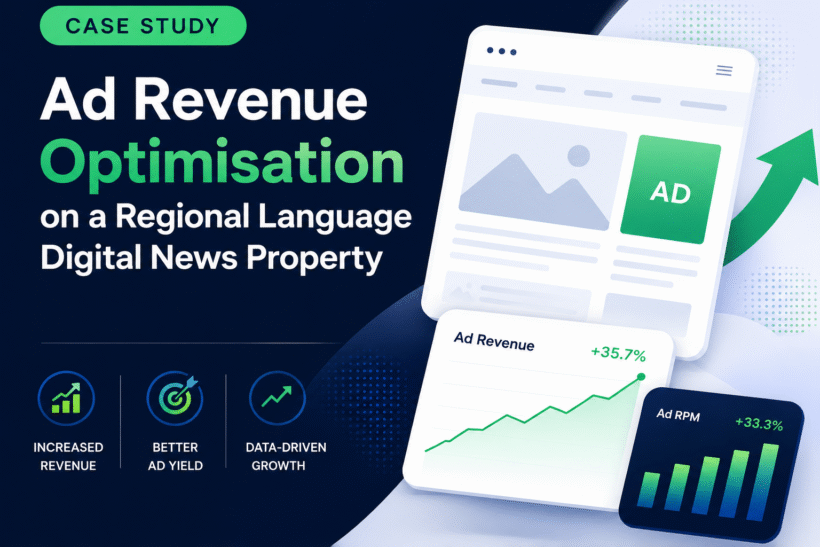
Ad revenue optimisation on a regional language digital news property

Case study Ad revenue optimisation on a regional language digital news property Tamil digital publishing · May 2026 · 7-day experiment window Programmatic advertising Floor price optimisation Ad format strategy AI-assisted analysis Revenue operations Revenue growth +53% vs pre-experiment baseline Impressions per page +21% on same traffic Imp RPM recovered 100% to pre-experiment baseline Fill rate (key market) +28 pts specific geography Background A Tamil-language digital news property with multi-million monthly pageviews, predominantly Indian audience with a growing diaspora readership across Southeast Asia, the Middle East, UK, Canada, Australia and the US. The site was monetising through Google AdSense and Google Ad Manager but had not systematically reviewed its programmatic setup. Traffic was not the problem. The gap was between what each page was earning and what it could earn. That gap turned out to be substantial. Diagnostic findings — before the experiment Critical issues identified Ad formats were not fully configured — a significant category of in-page formats was generating zero impressions. Roughly 60% of Indian pageviews were earning nothing from ads at all. Floor price issues No floor prices were set across any geography. Low-value and near-zero eCPM advertisers were winning auction slots unopposed, suppressing blended impression RPM across all markets. Revenue per page was proportionally lower than revenue per impression — confirming that the issue was structural, not audience-related. Better traffic monetisation, not more traffic, was the lever. Methodology Experiment → Observe → Analyse → Feedback → Rethink Each change was treated as a hypothesis. Positive signals were amplified. Negative signals were diagnosed and corrected before compounding. Days 1–2 · First floor prices set — early missteps Initial floors were set too aggressively in one geography — fill rate dropped sharply within hours. A second geography had floors set too low to filter anything meaningful. Both were corrected within 24 hours after early detection flagged the divergence. Day 3 · In-page ad formats activated Enabling previously inactive in-page formats increased impressions per page by over 20%. Impression RPM initially dipped as new lower-CPM slots were introduced — a known short-term dilution effect. Held the position. Days 4–5 · Floor refinement across geographies Manual floors replaced or supplemented by algorithm-optimised floors in markets where fill rate and RPM data indicated auto-optimisation would outperform static rules. Separate rules created for markets with different bid density profiles. Days 5–7 · Signals turn positive across all key metrics Revenue, impressions per page, fill rates and impression RPM all moved in the right direction simultaneously. Ad inventory quality review surfaced near-zero eCPM advertisers still bypassing floor prices — these were blocked directly at the ad server level. Results — days 5 through 7 Daily revenue +53% vs 8-day pre-experiment avg Impression RPM Fully restored after initial dilution dip Singapore fill rate +16 pts within 24hrs of floor change Largest market RPM +$0.01 above pre-experiment baseline US fill rate +12 pts from floor correction Canada fill rate 90%+ sustained across final 3 days Role of AI in the process AI was used throughout as a co-analyst — not to make decisions, but to do something more specific: detect directional signals earlier than the data alone would suggest. Where AI added most value Early trend detection. While a metric was still within acceptable range, AI flagged the trajectory — “if this continues, the experiment will go wrong in 48 hours.” That lead time allowed intervention before damage accumulated. How decisions were actually made AI suggestions were treated as one input. Sometimes the call was to act immediately. Sometimes: “let’s hold a little longer.” The AI adapted to that rhythm. Root cause analysis, pattern recognition and early warnings — AI. Final call — human. It is less “AI did this” and more “we figured it out together.” What this is not This is not a traffic growth story. Pageviews did not change materially during the experiment window. No new content was produced. No SEO or social strategy was involved. The gain came entirely from closing the gap between what the existing audience was worth and what the ad setup was capturing. That gap exists on most digital properties. It is usually larger than it looks. Note on timeline This experiment is seven days old. The results so far are directionally strong, but holding, compounding or revealing new problems to solve is the real test. A follow-up will be published when there is enough data to draw durable conclusions.

Continue Reading

📱 Social Media Isn’t Just Social — It’s a System Built to Sell Attention

I’ve been working in social media content marketing and digital strategy for over 10 years. One thing I’ve learned — and keep seeing more clearly every year — is this: Attention matters Social media isn’t just about connection or entertainment. It’s about capturing attention to sell ads. The platforms may talk about “community,” “creators,” and “expression,” but under the hood, the engine is the same:The longer people stay, the more data gets collected. The more data, the more precise the ads. The better the targeting, the more the platform earns. Here’s how the loop works: The uncomfortable truth: Your content doesn’t go viral because it’s “good” — it goes viral because it keeps people scrolling.It might be good. But the algorithm doesn’t reward value; it rewards engagement and retention. 🎯 Case Study: MrBeast crafts attention machine MrBeast isn’t just a YouTuber — he’s a master of attention engineering. His content is laser-optimized for: He doesn’t just make videos — he crafts attention machines. And the result? Billions of views. Not because he’s a better filmmaker, but because he understands what keeps people watching. The algorithm notices: “Oh, people are staying longer on this video — let’s push it to more viewers.” That’s not art. That’s algorithmic alignment. ⚠️ What This Means for Creators & Brands If you’re building a content strategy in 2025, here’s what to remember: 🧠 Final Thought As a digital strategist and a storyteller, this realization changed how I create.Now I ask: “Does this post hold attention? Or just exist?” Because in the attention economy, what holds — wins.

Continue Reading

From Viewer Feedback to Strategy: Why Sentiment Analysis is a Must-Have for Creators

The Hidden Power of YouTube Comments: How Sentiment Analysis Shapes Better Content When you manage a YouTube channel, every comment is a data point, a tiny window into your audience’s experience. But with thousands of comments pouring in, how do you separate actionable feedback from the noise? For me, the answer was sentiment analysis—a tool that has completely transformed how I approach content strategy. It all began with one of the channels I’m associated with. A new editor introduced fresh transition effects, which quickly caught viewers’ attention. Comments like “The effect works great in some places” became a recurring theme. We took that feedback seriously, incorporating the effect sparingly in future videos. The result? A subtle but noticeable improvement in how viewers connected with the content. On another channel, it went the opposite way. We experimented with sound effects for transitions, only to find 15 comments out of 2,000 mentioning the sound as “irritating.” That was enough for us to pledge never to use it again. These are small, subtle insights—but they matter. To scale this process, I tested Python scripts and sentiment analysis tools to evaluate feedback systematically. Eventually, I integrated sentiment analysis into my workflow, even developing a web app that leverages AI for smarter content decisions. (I’m in the final stages of launching—interested in testing? Ping me at thamiz@iniyan.in!) In one case, I analyzed a podcast video where I kept losing focus. The audience feedback confirmed my hunch: viewers found the anchor overly interruptive. The analysis wasn’t just about pinpointing the issue; it aligned my perception with theirs, proving the tool’s value. The Hidden Trends in Viewer Sentiment: A Lesson from YouTube Comments Sometimes, it’s not what viewers say—it’s when they say it that makes all the difference. One of the most fascinating insights I’ve uncovered using my AI-powered sentiment analysis web app came from a video that looked like a runaway success at first glance. This video, part of a channel I’ve been closely observing, initially received a flood of positive comments. Viewers praised everything from the visuals to the storytelling. Yet, something didn’t sit right with me. There was this subtle, nagging feeling that something was off. Curious, I added the video to my app’s testing list. The app analyzed the comments and generated a keyword sentiment analysis timeline. The results? Fascinating and alarming. For the first three days, the positive comments dominated, climbing steadily to the top. But then, on the fourth day, the trend reversed—negative comments started to rise, overtaking the positive ones. I replicated this analysis on a few other videos and found the same pattern. The initial feedback was overwhelmingly positive, but as the content reached a wider audience, the sentiment shifted. Why does this happen? Is it the honeymoon period of early viewers who are superfans or followers of the creator? Or does it reflect a broader audience discovering flaws that early viewers missed? Your chance to join the conversationI’m leaving this as an open question for you. What do you think causes such dramatic shifts in sentiment over time? Drop your thoughts in the comments below. The best, most accurate answer will win 3 months of premium access to my AI-powered sentiment analysis app—the ultimate tool for creators who want real insights from their audience. This trend taught me a critical lesson: sentiment analysis isn’t just about understanding your audience—it’s about tracking their evolving emotions. And sometimes, those shifts reveal insights that can change your content strategy entirely. Sentiment analysis doesn’t just simplify feedback—it amplifies it, showing how your audience truly feels. It’s a content creator’s secret weapon, and with tools like mine, it’s easier than ever to turn feedback into meaningful action.

Continue Reading